The new 2026 food pyramid is here, and while it promises a solution to our nation’s health epidemic, a closer look reveals a mix of helpful guidance, blind spots, and outdated thinking. Get a health coach’s take on it here.
The New Food Pyramid Explained: What Changed?
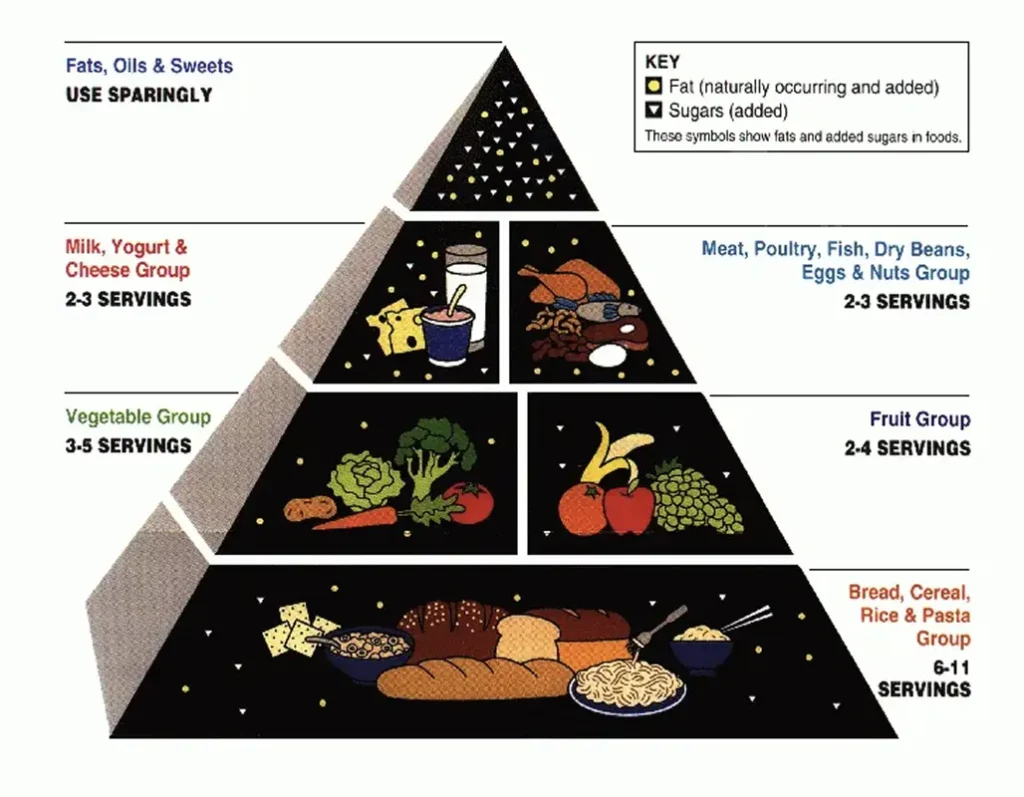
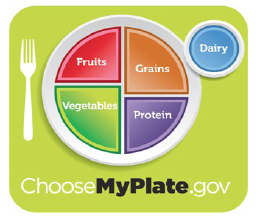
You may be thinking “Pyramid? What happened to the plate?” You’re right. In 2011, the government unveiled MyPlate, a replacement for the 2005 MyPyramid, which was the updated version of the food pyramid that many of us remember from the 90s. Dietary and nutrition guidelines are constantly being updated–which is a good thing. But, it can get very confusing trying to keep it all straight. I’m here to help with that! Here, I break down the pros of the new pyramid, the cons, and the misleading parts. I’ll end with a bottom line to ensure no one leaves here with any confusion. Now, onward!
The Good
When I first saw the new pyramid, I got so excited I ran through the house to find my husband and share it with him. I love the new emphasis on higher daily protein. I love the explicit directives to aim for real, whole foods and avoid ultra processed foods and added sugars. When you visit the USDA website explaining the new guidelines (realfood.gov), the first sentence is “Better health begins on your plate–not in your medicine cabinet.” Yes! Thank you for clearly spelling it out for Americans: food is medicine, and there are no pills that are going to bring you to better health the way a proper diet can. Sidenote: after you read this post, armed with some background knowledge, I urge you to check the website out–it’s actually quite well done and visually appealing.
Though serving sizes are not clear (more on that later), there is an emphasis on eating the right amount for your individual body, which is a positive, albeit fuzzy, message. The new guidelines also recommend steering clear of fried foods, refined carbs, and too much sodium. Plus, plus, and plus! Since I’m an optimist, I tend to always see the best parts of something first. The same thing happened here. I was so pumped…until some of the negatives started materializing through the happy haze.
The Bread (The Bad)
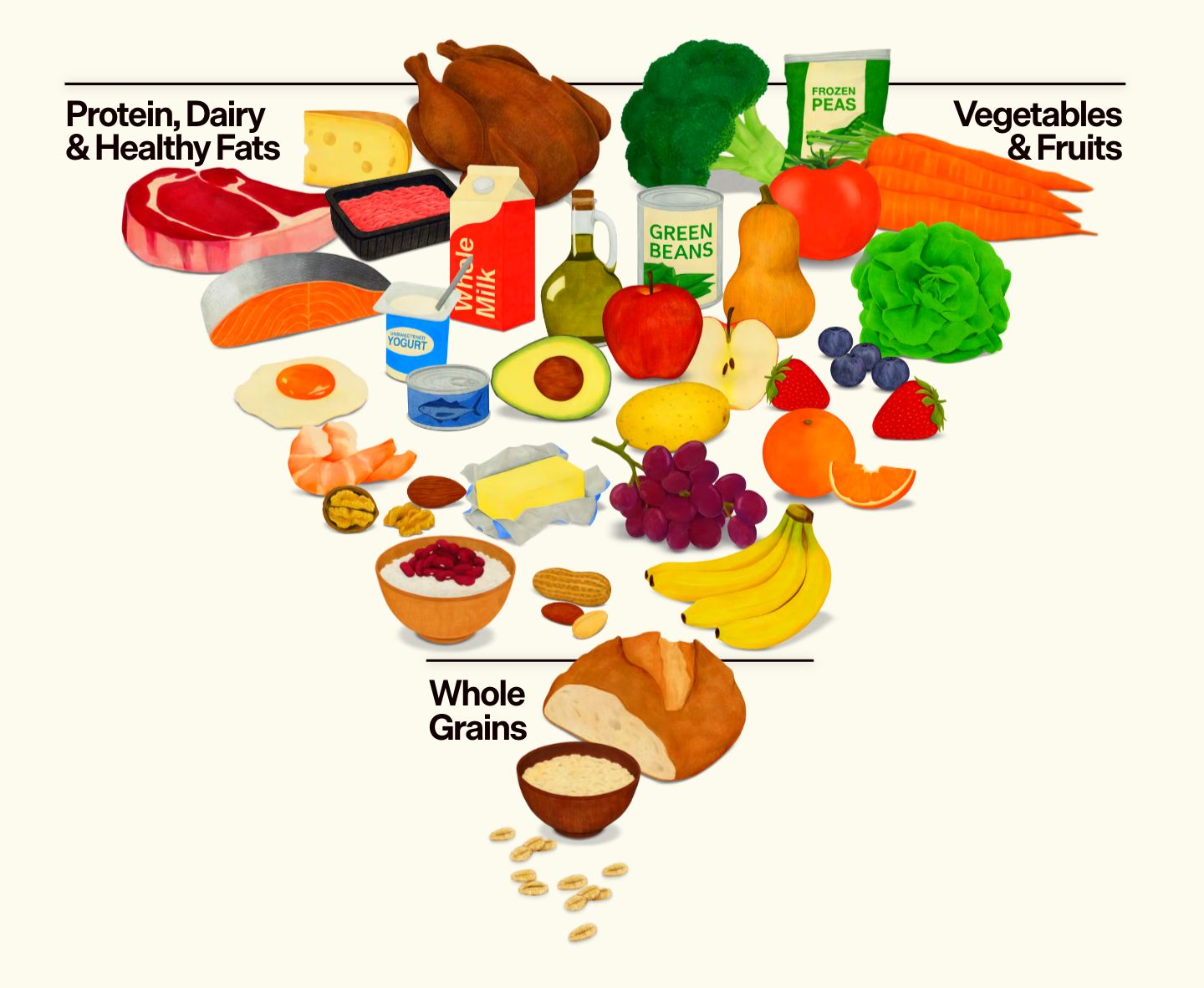
The main problem is that, although the new pyramid looks beautiful–and turns the original pyramid upside down, a subliminal message to Americans that we may need to completely flip the way we eat–it gives no concrete message about servings. The original 90s pyramid even had suggestions embedded in the graphic with suggested servings per day. MyPlate was a literal visual cue as to what your plate should look like at each meal. I think this was super helpful for most Americans who don’t typically count how many servings of a food group they’ve eaten, but can make their plate match the picture. It seems odd to me that the government would return to the pyramid after switching to the plate for such a long time.
The new pyramid lists only three groups: 1. Protein, Dairy, & Healthy Fats 2. Vegetables & Fruit 3. Whole Grains. There are no defined sections, other than Whole Grains being the smallest section at the bottom. The implication is to eat mostly protein, dairy, healthy fat, veggies and fruit, with some whole grain…but how much? If you do some digging on the website, you can find daily servings suggested, in the form of a confusing PDF that is not at all user-friendly. A little more digging reveals the protein suggestion “1.2–1.6 grams of protein per kilogram of body weight per day.” I’d love to know anyone in the US who measures their weight in kilograms.
For someone who is educated about nutrition, you can probably figure out what the suggestion is and apply it in a healthy way. But for the general population who get their nutrition information from…actually, where do the general population get their nutrition advice? The news? Googling? AI? If people are looking to the government, their new pyramid is too vague and gives little concrete advice.
I also think the Whole Grains category is tricky. The main image is still a giant loaf of bread. The bread most Americans eat is store-bought and full of sugars and chemicals. So while the text says “Whole Grains,” the brain sees the loaf of bread and justifies a host of refined carbs. I’d love to see more prominent images here of quinoa, oats, and brown or black rice. To be fair, there is a nondescript bowl of something pictured. Could be oats? I guess I should be happy there aren’t crackers, donuts, sugary cereals and cookies pictured.
Finally, while they won’t tell you specific servings, the new guidelines do go so far as to recommend beef tallow as a cooking fat. Literally, a spoonful of saturated fat (more on that soon). So it’s ironic to me that it’s recommended to stay away from fried foods, but to include beef tallow. Please don’t.
The Blind Spots
One of the larger groups recommended in the graphic is Protein, Dairy, and Healthy fats. This title has 3 problems:
- Protein, for many people, translates to “meat.” And for many within that group, this translates further to “red meat.” Red meat has proven to be highly inflammatory and stocked full of saturated fat. A lot of people don’t realize that some of the best sources of protein are not meat at all: beans! Also high in heart-healthy fiber, beans truly are a magical fruit. Research has shown time and time again that plant-based diets lead to lasting health and less chronic disease. Other lean and healthy protein sources are eggs, fish, non-fat plain Greek yogurt and cottage cheese, poultry, and quinoa.
- Dairy is great! The problem with the new guidelines is that they recommend full-fat dairy. Which is full of saturated fats. Full fat dairy should be eaten in moderation, but anyone blindly following the new pyramid is at a huge risk for consuming way too much unhealthy fat.
- Speaking of fat, let’s get to the third problem. A lot of people will see “healthy fats” on the pyramid and not necessarily take the time to research what that means. To make sure at least we are on the same page here, let’s agree: healthy fats mean fats that come from mostly non-animal sources. Nuts, avocado, olive oil, seeds, fatty fish, and eggs. To get a little science-y, these are monounstaurated and polyunsaturated fats (this includes omega-3), which are essential to your body’s healthy functioning. Saturated fats are the kinds we want to largely avoid, comprising just a small percent of our overall diet. These are found in animal products: beef, pork, full-fat dairy, cheese, butter, lard. Too much saturated fat has been linked with heart disease.
Some of you may be thinking…what does this even matter? I don’t tend to rely on the government for nutrition advice anyway! (Smart move). Here’s the thing: any program funded by the government and in charge of feeding people uses the pyramid and guidelines to construct its meals. This includes public school lunch programs, the military, Head Start and SNAP benefits. The big oversight here is that the government, if they are going to follow their own nutrition advice, is going to have to allot a TON more money into these programs to start including more real, whole foods and less processed, packaged foods. Which I hope they do! But I also hope the new meals do not include too many saturated fats, prolonging the nation’s chronic heart disease epidemic.
The Bottom Line
Here is my general, healthy balance nutrition advice to most people:
- Make each meal a combination of lean protein, complex carbohydrates, and healthy fat
- Avoid added sugars and refined carbs
- Avoid packaged & processed foods
- Eat real food
And actually, the 2026 pyramid does echo these ideas for the most part. I think it’s essential that they be much more clear on what constitutes lean protein sources, complex carbs, and healthy fats. Maybe that will be included in the next revamp! Until then…
In health,
Nicole